

With Spring in the Air, Chongqing Embarks on a New Journey: "Six Zones and One Highland" Initiative Maps Out a New Blueprint for Modernization
As spring tides surge through Chongqing, the moment calls for steadfast action.
For a city, the "First Meeting of the New Year" often sets the tone for the year ahead.
A year ago, Chongqing's "First Meeting of the New Year" sounded the charge, upgrading and refining the framework for building the "Six Zones and One Highland". Over the past year, 32 million residents have forged ahead with determination, turning blueprints into reality and aspirations into tangible results.
A range of statistics testifies to this progress: In 2025, Chongqing's GDP exceeded RMB 3.37 trillion. The city reclaimed its title as "China's No. 1 Automobile City". Its total retail sales of consumer goods ranked first among Chinese cities, and total foreign trade import and export volume surpassed RMB 800 billion for the first time.
Vivid scenes reflect the city's vitality: intelligent factories hum with activity; rural fields yield abundant harvests; base-level officials work with renewed efficiency; and the "Two Rivers and Four Banks" are lush and green.
From plans on paper to concrete achievements, every step in advancing the "Six Zones and One Highland" initiative has been grounded in pragmatic action, revealing the determined stride of a modernizing Chongqing.
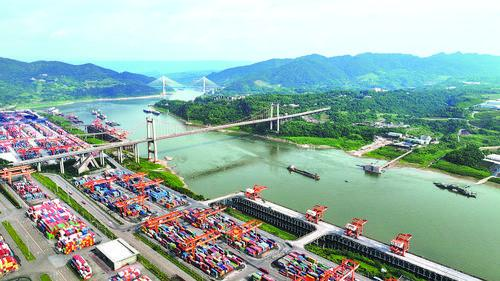
▲ Guoyuan Port in Chongqing, where cargo vessels move in steady and orderly flows. (File photo) Special photo by Zhong Zhibing/Visual Chongqing
High-Quality Development Enters the Fast Lane
High-quality development stands at the heart of Chongqing's advancement in the new era.
To build a leading zone for high-quality development in the western region, Chongqing has made industrial development its core focus. Using the "33618" modern manufacturing cluster system as its framework, it promotes deep integration of science innovation and industry, continuously strengthening the momentum for high-quality development.
A few days ago, at the Seres Super Factory in Liangjiang New Area, the AITO M8 and M9, which consistently lead the national premium new energy vehicle market, rolled off the production line in succession.
From a small spring factory to an auto parts supplier, and then to a new energy vehicle leader operating a world-class benchmark smart factory, Seres' transformation is a vivid microcosm of Chongqing's automotive industry upgrading.
In 2025, Chongqing's automobile production reached 2.788 million units, accounting for 38.6% of the western region's total output. With solid strength, it has reclaimed the title of "China's No. 1 Automobile City", and its influence as a capital of new energy and intelligent connected vehicles continues to rise.
The momentum extends beyond the automotive industry. In 2025 -
Chongqing's laptop production maintained its position as the world's No. 1 for the 11th consecutive year;
The new materials industry emerged rapidly, with the flexible display industry scale ranking among the top five nationally, and fiberglass production capacity ranking first in the west and third nationwide;
Seven independent products were successfully selected as national "first unit (set)" of major technical equipment products, the highest number in western China;
The scale of the software and information service industry entered the national "first tier";
The value added by the service industry accounted for 58.8% of GDP, ranking first in western China;
The "Artificial Intelligence+" action was comprehensively promoted, with artificial intelligence becoming a new engine for industrial upgrading.
From traditional manufacturing to intelligent manufacturing, from single industries to industrial clusters, and from factor-driven growth to innovation-driven development, Chongqing, with its robust industries, shoulders the responsibility of being a leading zone for high-quality development in the western region, striving to secure a leading position on the national track of high-quality development.
An Inland Heartland Emerges as an Open Frontier
On January 27, a shipment of industrial machinery components departed slowly from Xiaonanya Railway Station. After traveling by rail to Qinzhou Port in Guangxi, the goods will be transferred to an ocean vessel bound for Nigeria. This marked Chongqing's first export under the new sea-railway multimodal transport pilot program following the implementation of updated policies by the General Administration of Customs.
Once an obscure fourth-class freight station, Xiaonanya Railway Station has now become a key hub of the New International Land-Sea Trade Corridor in western China.
Over the past year, Chongqing has worked towards establishing itself as a leading zone for international cooperation in inland opening-up, surmounting obstacles and building bridges to transform its hinterland location into a new frontier of openness.
Expanding open corridors -
The New International Land-Sea Trade Corridor now connects 584 ports across 127 countries and regions;
The cumulative number of China-Europe Railway Express (Chengdu-Chongqing) trips ranks first nationwide;
Jiangbei International Airport has joined the global "50 million passengers" club in terms of annual throughput.
Strengthening open platforms -
China (Chongqing) Pilot Free Trade Zone has cultivated 187 institutional innovation achievements, ranking among the top in western China. Its pioneering "cross-border railway bill of lading financing practice" offers a "China solution" for new global land-based trade rules;
CCI has entered a new phase, evolving from "Chongqing-Singapore connection" to "Western China-ASEAN cooperation", driving annual trade between western China and ASEAN countries past the RMB 1 trillion mark;
Construction of the Chongqing Hub Port Industrial Park has accelerated, with industry leaders like CSSC and MCC speeding up their settlement. In 2025, 242 new projects were signed, started, or put into operation, with a total investment of RMB 187.5 billion, establishing a new carrier for the open economy.
With its doors opening ever wider and its cooperative platforms expanding, Chongqing's foreign trade import and export volume surpassed RMB 800 billion for the first time in 2025, reaching a record high. The city's function as an comprehensive hub for inland opening-up has achieved an overall leap forward.
Reform Fuels Internal Growth
Reform is the key to unlocking and advancing productive forces, and it serves as the "golden key" for Chongqing to solve development challenges and stimulate vitality.
Over the past year, Chongqing has focused on building a pioneering zone for comprehensively deepening reform, pushing reforms into uncharted waters.
Economic system reforms have unleashed significant momentum. The Chengdu-Chongqing Comprehensive Science Center became the nation's first cross-regional collaborative science and technology platform. The "first-report filing system" for investment promotion has been promoted nationwide. The Convention on Negotiable Cargo Documents for China-Europe Railway Express was adopted by the UN General Assembly. Nine innovative cases from the free trade zone have been replicated nationwide.
State-owned assets and enterprises, the pillar of the national economy, have undergone deep restructuring. Chongqing streamlined its key municipal SOEs to 33 entities, optimizing layout, improving efficiency, and rationalizing structure. At the same time, efforts to revitalize state-owned assets have been intensified: in 2025, municipal SOEs revitalized RMB 103.37 billion in existing assets, steadily enhancing competitiveness and dynamism.
The private economy is a vital component of the market economy. Chongqing has dedicated significant effort to creating a highland for private economic development. It took the lead nationwide in establishing a three-tier (municipal, district/county, and township/sub-district) checklist of enterprise-related inspection items. It was also approved as the country's only provincial-level pilot zone for comprehensive reforms in market-oriented allocation of production factors, enriching the environment for private economic growth.
The ultimate goal of reform is to ensure that the people share in the fruits of development.
Over the past year, Chongqing has continued improving its public service system for prosperity and well-being. It became the first region in central and western China to achieve full coverage of a three-tier elderly care service network, ensuring reliable support for seniors; It pioneered a public rental housing "rent-to-own" reform, helping many families realize their dream of secure housing; The city's inclusive preschool education rate ranks sixth nationwide, enabling children to access high-quality and equitable early education.
From the reform of state-owned assets and enterprises to private economy empowerment, from factor market liberalization to upgraded public services, Chongqing's reform agenda has targeted pain points, removed obstacles, and cleared blockages, spreading the fresh momentum of reform throughout Chongqing.
Smarter Governance Powers the Megacity
Chongqing, a megacity with a population exceeding 30 million, presents significant governance challenges. Building a demonstration zone for modernizing the governance of such a megacity is no small feat for the city.
Over the past year, guided by the development of Digital Chongqing and focusing on reducing the burden on base levels, Chongqing has forged a new path toward a livable, resilient, and smart megacity governance model.
"In the past, I was overwhelmed just completing reports. Now, I have much more time to serve the people!" exclaimed Hu Xiaoyan, a civil affairs official in Zhutuo Town, Yongchuan District.
Previously, she had to complete a vast number of reports - annual, monthly, weekly, and daily. Now, the "One-Table-Through" system developed in Yongchuan enables real-time data aggregation, intelligent filling, and on-demand extraction. The average monthly number of reports required from towns and sub-districts has been reduced from 115 to just 11, and the time needed to process a single report has dropped from an average of two hours to ten minutes.
This is not an isolated case. The "One-Table-Through" system has now been promoted throughout the city, covering municipal departments, districts and counties, 1,031 townships and sub-districts, and 9,892 villages and communities. The number of base-level reports required, the time spent on them, and the personnel involved have all been reduced by over 70%.
Reducing the base-level burden is just one facet of this governance upgrade.
Chongqing has comprehensively enhanced the core capabilities of Digital Chongqing. The practical ability for cross-system, cross-departmental collaboration within the three-tier digital urban operation and governance centers has significantly improved. The construction of the city's integrated public data resource system leads the nation. It has built the country's first provincial-level, full-coverage, fully integrated digital twin system for underground pipelines, enabling second-level response capabilities in urban governance.
In the central urban areas, Chongqing took the lead in establishing a new "Integrated Comprehensive Management" institutional mechanism for comprehensive urban governance. Land spatial management now achieves "unified control through one map", continuously enhancing the precision of urban management.
Artificial intelligence is also being harnessed to manage the city. Five high-quality datasets and four trusted data spaces have been included in national pilot programs. A unified city-level artificial intelligence infrastructure has begun to take shape, with artificial intelligence widely applied in areas such as traffic management, making daily life more convenient and efficient.
Urban-Rural Integration Reshapes the Landscape
The Chinese path to modernization is one that advances through urban-rural integration. Without rural revitalization, there can be no comprehensive modernization.
Over the past year, Chongqing has focused on building a demonstration zone for urban-rural integration and rural revitalization, promoting the two-way flow of factors and the coordinated allocation of resources between urban and rural areas. It is painting a beautiful picture of urban-rural complementarity, coordinated development, and shared prosperity.
"29,500 tons for Beijing, 10,000 tons for Shanghai, 27,300 tons for Chengdu..." Applause filled the venue at the 2025 Fengjie Navel Orange Global Ordering Fair, where 189 distributors from across the globe signed deals totaling 250,000 tons, with a total value exceeding RMB 1.7 billion.
In 2025, the brand value of Fengjie navel oranges surpassed RMB 38 billion, ranking first among Chongqing's agricultural products and increasing incomes for hundreds of thousands of residents.
Beyond Fengjie navel oranges, other Chongqing specialty products, including Fuling pickled mustard tuber, Wushan crisp plums, and Jiangjin pepper, also made their way from the mountains to the global market in 2025. Six industrial brands ranked first nationally in their product categories in terms of brand value.
In rural development, Chongqing has advanced the "Four-Thousand Action Plan". In 2025, 2,927 new beautiful and harmonious villages were established.
To improve connectivity, the city has accelerated construction of the "Two-Hour Chongqing" transportation circle. Rural road mileage has reached 168,000 kilometers, with network density ranking first in western China, significantly narrowing the spatial gap between urban and rural areas.
Through reforms aimed at strengthening rural communities and boosting farmers' incomes, rural property rights transactions exceeded RMB 6 billion in 2025. The "five networks" of water, roads, electricity, telecommunications, and logistics in rural areas have been fully integrated into the city's main arteries.
Chongqing Is Becoming a More Beautiful City of Mountains and Rivers
Lucid waters and lush mountains are invaluable assets. A sound ecological environment is the most inclusive form of public well-being.
In early spring, at Zhenying Wharf along the Yangtze River in Yunyang, groves of navel orange trees now flourish. Just a few years ago, this riverside site was a coal transport terminal shrouded in dust and ash.
The transformation from a "coal port" to an "ecological shoreline" epitomizes Chongqing's efforts to pioneer Beautiful China initiatives.
Over the past year, the city advanced an integrated, citywide environmental campaign known as the "Nine Governance" initiative. The water quality in the Chongqing section of the Yangtze River's main stem has achieved "nine consecutive years of excellence", while the number of days with good air quality has exceeded 325 annually for six straight years. Blue skies above and greenery at the doorstep have become everyday realities.
Over the past year, the "Lush Mountains on Both Banks, Thousand-Mile Forest Belt" program has been expanded, with more than 2 million mu of projects implemented, making the Yangtze's banks ever greener;
Over the past year, strict enforcement of the ten-year fishing ban along the Yangtze River has continued, with 52 additional fish species recorded in the monitoring scope of Chongqing section of the Yangtze River's main stem compared with pre-ban levels;
Over the past year, carbon trading and green finance have been vigorously developed. Cumulative carbon market transactions have surpassed 54 million tons, while outstanding green loans have exceeded RMB 1 trillion.
Over the past year, urban aesthetics has improved markedly. A total of 70 kilometers of waterfront along the "Two Rivers and Four Banks" have been rehabilitated, and 18 high-quality public waterfront spaces created, enabling the city to blend harmoniously with its rivers and greenery.
Today, Chongqing's energy consumption per unit of GDP is about 30% lower than the national average. Green development has become a defining hallmark of its high-quality development.
A New Wave of Initiative and Entrepreneurship Gains Momentum
To accomplish China's goals, the key lies in the Party; To accomplish Chongqing's goals, the key lies in its Party members and officials. Building a new highland of Party leadership at the municipal level is both the fundamental guarantee for advancing the "Six Zones and One Highland" initiative and the cornerstone of modernizing Chongqing.
Over the past year, Chongqing has continuously refined the "885" working mechanism led by Party building, forging transformative "Red Crag Pioneer" organizations. The vast majority of Party members and officials, with the demeanor of strivers and creative drive, have demonstrated their capabilities in the construction of a modernized new Chongqing.
In 2025, a juvenile protection team from the Chongqing procuratorial system was honored with the national title of "Role Model of the Times", becoming the first collective in China's procuratorial system and the first in Chongqing to receive this distinction.
This team is but one example among thousands of "Red Crag Pioneer" organizations across the city. On the construction site of Chongqing Rail Transit Line 17, Party-led task forces overcame technical challenges, making Gaolong Avenue Station the first on the entire line to complete its main structure topping-out. At the Chongqing Steel Plant, the Party branch led Party members and employees to reduce costs and increase efficiency, achieving cumulative cost savings of RMB 15.12 million in deoxidation alloy consumption per ton of steel since 2025. At the Huimin Sub-district Market Supervision Office in Banan District, Party members and officials proactively offered door-to-door service, completing the breakfast shop owner's food operating license renewal procedures within half a day.
Over the year, Chongqing established 10,663 enterprise-specific Party organizations under the "one enterprise, one policy"' model, created more than 28,000 Red Crag Pioneer task forces and demonstration posts, and streamlined 195 mobile government service applications, reducing them by nearly 60%, allowing officials to devote more energy to practical work and public service.
A year of hard work. A year of determined progress.
Across the land of Chongqing, the "Six Zones and One Highland" initiative has taken root and flourished. We have witnessed industrial transformation and breakthroughs in openness, governance upgrades and rural revitalization, ecological renewal and a spirit of pragmatic competition. Above all, we have seen the courage and drive of Chongqing's people.
With surging tides on the broad Two Rivers, we press forward with renewed resolve.
As the "15th Five-Year Plan" kicks off in 2026, 32 million Chongqing people, standing shoulder to shoulder, will continue with the vigor of prioritizing action and a style of striving for excellence and practicality. We will continuously expand the achievements of the "Six Zones and One Highland" initiative, strive to write a new chapter of Chinese path to modernization in Chongqing, and let the surging tides of the Two Rivers echo powerfully throughout the new era.
Source: Chongqing Daily

 渝公网安备 50010502003501号